LESSON PLAN OF SOLVE REAL LIFE PROBLEMS INVOLVING DIRECT AND INVERSE PROPORTION BY UNITARY METHOD
LESSON PLANNING OF SOLVE REAL LIFE
PROBLEMS INVOLVING DIRECT AND INVERSE PROPORTION BY UNITARY METHOD
Subject Mathematics
Grade 5th

Students` Learning Outcomes
- Solve real life problems involving direct and inverse proportion [by unitary method]
Information for Teachers
- In unitary method we deal with the following;
§ Finding the price of more things when price of one thing is given.
§ Finding the price of 1 thing if price of more things are given.
§ Finding the price of given number of things if the price of other number of same things is given.

§ During lesson where necessary also consult with textbook.
Material / Resources
Writing board, chalk / marker, duster, chart paper, packets or
tins of food items, textbook
Introduction
- Show students a packet of juice and read the information for ingredients.
- The label on juice pack shows this information
- Apple juice 440 ml. each 440 ml provides;
o Energy 226 calories.
o Carbohydrates 6.6g.
o Vitamin C 20 mg
- Ask the students that if 440 ml of juice provides 226 calories how many calories 100 ml of juice will provide?
- Ask students to decide is it direct or inverse proportion question, can they show the working? If they are unable to do, then show working on the board.
- Solution:
440 ml of juice contains calories = 226
1 ml of juice contains calories = 226 + 440100 ml will contain = 226/440 x 100 = 56.5 cal.
- Ask again is it direct or inverse proportion and why?
Development
Activity 1
- Discuss the following questions with the whole class.
- What is ratio?
o A ratio shows the relative sizes of two or more values.
o Ratio means a relation between part to part or part to whole.
- What is proportion?
o When two ratios are equal they are said to be in proportion.
- If increased in one quantity causes decrease in other quantity or decrease in one quantity, then we say that both quantities are inversely related.
- Two values are in “direct proportion” with each other if the following relationship holds: whenever one variable doubles, the other variable doubles, the other variable doubles. Whenever one variable triples, the other variable triples and so on.
- Ask the students “Do you remember the proportion tables we did in the previous lessons?”
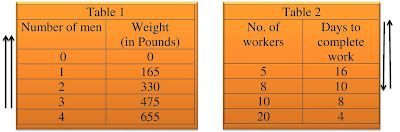
- Show them following tables and recollect
the information about direct and inverse proportion.
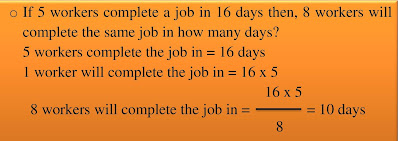
- Solve table 2 on the board with the help
of the students.
- Change the number of workers and practice further.
- After completing the examples give students in pairs, questions from textbook exercise.
- While students are working, keep roaming in the class, correct students if they make any mistake.
Activity 2
- Write some statements of the questions for direct and inverse proportion on paper slips.
- o
These questions can be taken from
textbook or you can make this yourself.
- Prepare enough slips that each student gets one slip.
- Distribute these slips in the students.
- Ask students to read the statement, write is it direct or inverse proportion? And then solve the question.
- Collect back the solved slips shuffle and redistribute among students, to read and check the question of each other.
Sum up / Conclusion
- Conclude the lesson with the following points;
o All mathematical concepts are lying as situations in out daily life.
o When two values are increasing or decreasing at the same time in the same ratio, it is direct proportion.
o When two values are in relation such that one value increases other decreases, it is inverse proportion.
Assessment
- Ask students to solve the following questions in their notebooks.

Follow up
- Ask students to suggest solutions for following situations;
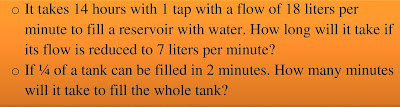
Ask students to suggest solutions for following situations;


Comments
Post a Comment